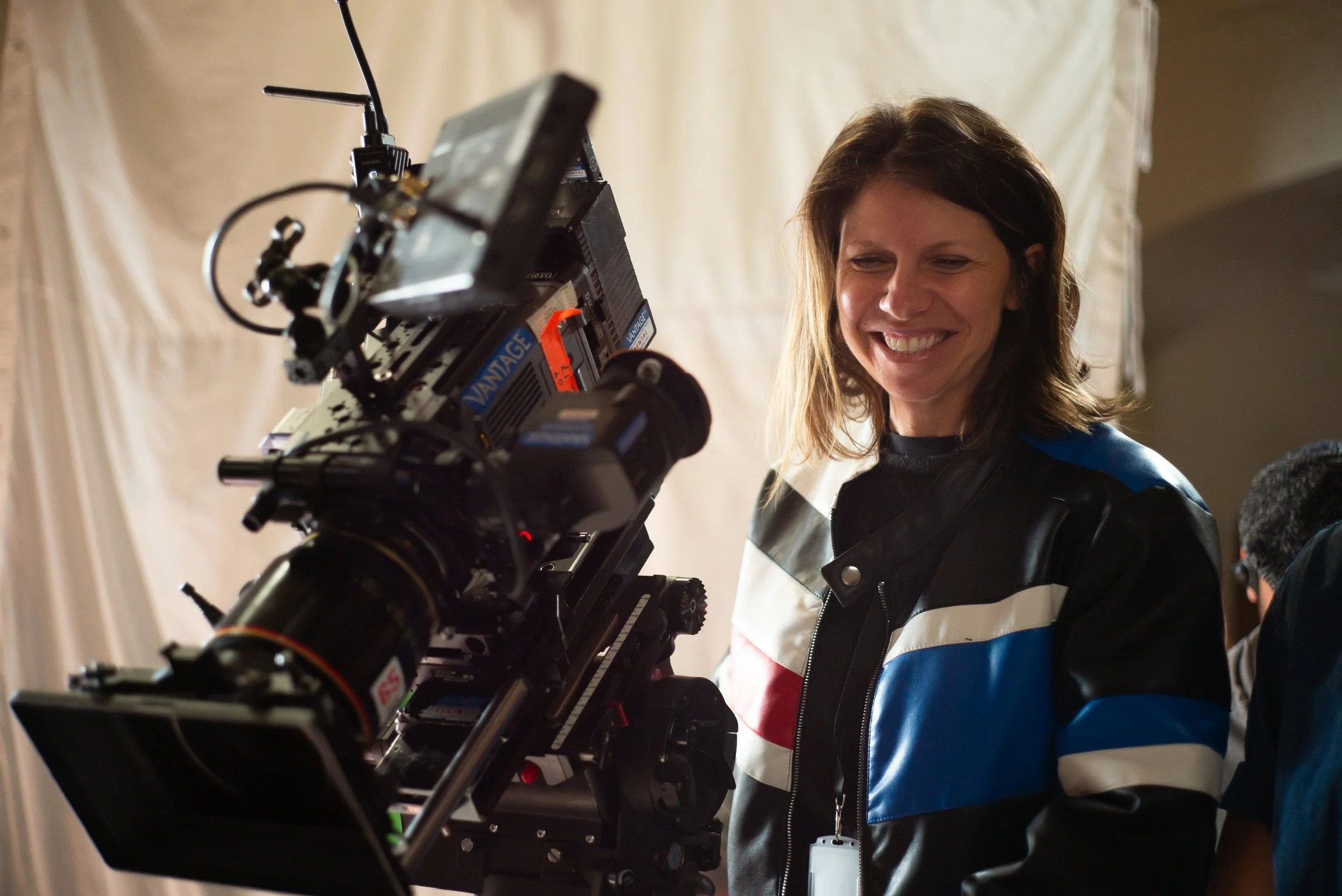
Valerie weiss: director on star trek: strange new worlds, outer banks, & NCIS: tony and ziva on fortifying the human heart that beats in every story

Written by: Milla Nguyen
Valerie Weiss’s Biography:
Award-winning film and series director Valerie Weiss is drawn to stories that explore complicated human relationships in feel-good ways. She has infused this tonal complexity into her feature films and dozens of television episodes, both in the streaming and broadcast space, while spanning the genres of action, thriller, drama, science-fiction and comedy. Most recently, Weiss directed two episodes of the Paramount+ series Star Trek: Strange New Worlds. Her episodes were praised as "instant classics" and her episode "The Sehlat Who Ate Its Tail" puts the iconic Kirk in the Captain's chair for the first time. Weiss also directed an early block of the new NCIS: Tony and Ziva spinoff for Paramount+ as well as a new series for Prime Video called It’s Not Like That starring Scott Foley. Prior television work includes the finale of Netflix’s limited series Echoes for showrunners Brian Yorkey and Quinton Peeples in addition to five episodes of Netflix's global YA sensation Outer Banks. She has directed multiple episodes for several of television's biggest producers including Shonda Rhimes, Dick Wolf, Greg Berlanti and Marc Cherry. Weiss began her career in independent features, having directed her award-winning dramatic debut, A Light Beneath Their Feet, starring Taryn Manning, and The Archer, which premiered at SXSW. Her first studio film was Netflix’s Mixtape starring Julie Bowen and Nick Thune. Mixtape is a nostalgic coming-of-age musical odyssey that scored a 100% on Rotten Tomatoes, ranked as one of the Best Family Films of 2021 by the Washington Post, and labeled one of the 17 Best Happy Films by Entertainment Weekly. Weiss has an intriguing background, having studied X-ray Crystallography at Harvard Medical School, earning a Ph.D. in Biophysics and a master’s degree in medical science. Although well on her way to unlocking the molecular mysteries of the universe, she was irrepressibly drawn to the larger scale mysteries of human nature and pivoted to pursue her lifelong passions in the entertainment industry. Very involved in her guild, she is currently Co-Chair of the DGA’s Women’s Steering Committee as well as on the DGA’s Sustainable Future Committee and the Special Projects Committee (appointed by President Glatter).
Author’s Note
Interviewing ground-breaking director, Valerie Weiss, is a true highlight of Issue three. Valerie Weiss has made her mark in the industry with an extensive portfolio of directorial projects. The scope ranges from the emotionally charged moments in medical dramas Chicago Med and The Resident, edge-of-your-seat action sequences in Outer Banks and Star Trek: Strange New Worlds, and female-driven genre-benders, The Archer and Why Women Kill. In fact, one common denominator binds all of her works together– the human heart that beats within all of these stories. During our conversation, I recognized Weiss’s ability to analyze the human subtext beneath the surface. She creates characters that defy their fears, and causes us to face our fears while watching them.
Valerie Weiss’s Inner Child
Valerie Weiss was born and raised in Philadelphia, Pennsylvania. Being the youngest of three siblings and close to her parents, she found that creativity was a way to express her voice inside and outside the home. She was insatiably curious and always asked questions, even if she didn’t receive definitive answers. Weiss recalled how her school friends were peas in a pod, constantly tapping into the magic of storytelling. In their free time, they would write musicals and operas as a group, later performing them at school. She said, “It was an era where kids were always playing outside until dinner time. Sometimes, we would grab my parents’ camcorder and film fake commercials on it. Everything was filled with imagination.”
Diverging Paths: Taking the Path Less Traveled By:
At first, Weiss wanted to be an actor. In her mind, acting was a way to experience many different lives through characters. However, her father was worried that acting and filmmaking would not be a sustainable career; a worry that many young filmmakers still harbor today. To compromise, she attended Princeton University, where she majored inmolecular biology and minored in theatre and dance. One fateful night, the theatre club asked her to direct a play they were planning to put on. Long story short: she said yes. This is when her spark for directing grew into a flame. Still, given the circumstances, she wasn’t ready to fully commit yet. She ended up pursuing her Ph.D. in biological chemistry and molecular pharmacology and a Master's degree in medical sciences from Harvard Medical School. When speaking about the experience, she said, “I wanted to extend my coming-of-age story as a scientist and artist. Not only that, but the experience of education was fruitful for me. My thesis advisor was so supportive of all my projects; he even saw my plays.” She credited her advisor for giving her impactful life advice. He told her, “People remember you for how you finish something. The end is what counts.” This empowered her to finish her Ph.D. rather than quitting halfway. Later, she founded the Harvard Dudley Film Program and became the Artist-In Residence. This extracurricular initiative encouraged students of all majors to make short films and showcase them among their peers. While the program is not active today, the university later invested resources to create film studies and collaborative production degree programs.
The Courage to Be a Filmmaker
Finally, after finishing up her time at Harvard, she decided to make the daunting leap. She did not want to let her passion for directing go. She hung up her medical coat and has never looked back since. Reflecting on this journey, she lent sound advice for those concerned. It is no secret that in the ever-changing landscape of Hollywood, many filmmakers face the realities of low stability, pay cuts, and few opportunities. However, in the grand scope of it all, careers beyond the arts face the same struggles. She reinforced, “Let the fact the careers that were once considered secure are not anymore. Let this be liberating. On one of my projects, I was faced with making a risky decision about where the shooting location would be. A colleague reminded me to make my own mistakes. Life is short; there’s no real safe option. Make your own mistakes, but learn from them.”
Star Trek: Strange New Worlds: Is it a Mirror of Humanity?
Weiss recently directed episodes “Ad Astra Per Aspera” and “The Sehlat Who Ate Its Tail” for Star Trek: Strange New Worlds, a spin-off of the original franchise. “The Sehlat Who Ate Its Tail” is a unique take on young Captain James T. Kirk’s story and his first time being a full-fledged leader in a dire situation. The episode sets up Captain Kirk’s and Captain Pike’s mission to protect their respective crews, ships, and communities against an enemy alien fleet. While Kirk encounters challenges and rifts in his crew, he musters the courage to step up to the plate. Launching a final attack on the enemy aliens, his crew saves the day. (Spoiler: the twist reveals that the aliens had taken a human colony hostage, and Kirk has just eliminated them all). At the end of the episode, Kirk and Pike reflect on wiping out the humans and question their survival. Weiss discussed her intentional directing choices, “I want to make something that has a lasting message but is also commercial, that goes down easy. I wanted to intercut a young leader and a seasoned leader. Leadership isn’t about bravado and salesmanship; it’s about thought and empathy. To capture someone as revered as Captain James T. Kirk, I was glad that Paul Wesley went on a deep journey with me to bring this character to life.”
NCIS: Tony & Ziva: Female-Centric Action NCIS:
Tony & Ziva episodes, “Cover Story” and “Wedding Crashers” dial in on Ziva being a boss lady spy, serving sequences that pack a knock-out punch, literally. Framed for a robbery, agents Tony and Ziva must go undercover to lure enemy agent Martine during a fake wedding. There are notes of Ziva’s and Tony’s romantically subtle moments in the will they, won’t they game. These scenes are juxtaposed by Ziva’s female rage when she encounters a traitor, beating him up while she’s in a wedding dress. Weiss explained, “I love stunts. And I choreograph them in a character-driven way. I wanted to show how a woman could be married but can get the job done. With these scenes, I also like to walk through the locations and place them throughout the script. As you’re watching, you feel like you are Ziva in her perspective.”
Outer Banks: Shaping Hits in Young Adult Television
I first discovered Valerie Weiss through her significant work on Netflix’s hit show, Outer Banks. For context, the young adult coming-of-age story has accumulated over 200 million views across its seasons and continues to generate Gen Z hype on social media. It follows a group of rag-tag North Carolina teens: John B, JJ, Pope, Kiara, Sarah, and Cleo, known as “The Pogues” during their hunt for mysterious treasures. Weiss directed top episodes “Dead Calm”, “The Dark Forest”, and more. My personal favorite, “Dead Calm”, gives a strong insight into JJ Maybank’s tumultuous relationship with his abusive father, as well as igniting the sparks of his eventual romance with fellow Pogue, Kiara Carrera. It is also the first episode when audiences cement John B’s and Sarah’s intimate relationship for real. Weiss recalled, “Outer Banks was so much fun. I worked with showrunner Jonas Pate, and he gave me freedom to create. The cast was so new in season one, but so full of heart. They were so prepared and showed up to set with alternate lines and little gimmicks. The chemistry was real on screen and off-screen. Between the treasure hunt, murder, and boat chases, it amplified the coming-of-age effect.”
Has Dr. Valerie Weiss used her medical knowledge on Chicago Med & The Resident ?
The answer is yes. She directed several episodes of these iconic medical dramas, utilizing her medical science knowledge. As she retold her experiences, she said, “I remember being interviewed by Michael Waxman, the pilot director and co executive producer of Chicago Med. When he was interviewing me, he saw that I graduated from Harvard Medical School and hired me. I also had a meeting with a medical consultant which was three hours long. I researched the equipment and the diseases that these characters had. My episode was about a father and mother transplanting an organ to their daughter. It was a triple-transplant with three operating rooms intercut at once.” In conclusion, the best way to research something before a directing stint is to visit locations, interview experts, and do it, for real.
Highlighting Female-Driven Stories
Weiss’s original feature films, The Archer and A Light Beneath Their Feet, both explore multi-layered female characters who are driven by purpose. I was especially drawn to The Archer, which follows two young women who escape from a prison camp facility with only a bow and arrow and each other. The film is beautifully shot, with scenes featuring a strong young woman taking aim at those who come to harm her and her friend, no matter the cost. When Weiss first started directing, she was also selected as a finalist for the AFI Directing Workshop for Women, where she submitted a short film idea of an all female cast version of The Maze Runner to 21st Century Fox. A major throughline in Weiss’s career is her mission dedicated to uplifting female-driven stories and initiatives. She said, “I am the Co-chair of the DGA Women’s Steering Committee. We have an initiative called the Squad Mentorship, where we uplift mid-level female directors. When I got started, I was a part of the Directing Intensive Initiative, mentored by director Roxanne Dawson. Being a part of these organizations and initiatives allows me to pay back my community.” Weiss also serves on the all inclusive sustainable futures initiative, encouraging productions to reduce plastic waste and paper usage.
Future Projects
In terms of future projects, she is working on a romantic comedy that explores complex female characters and their equal partnerships with the men in their lives. She is also slated to direct a number of television projects from major studios.
Acknowledgements
Finally, I asked her if there was anyone she would like to thank for supporting her in her career. She mentioned her husband, who has stuck by her side since their college days. Weiss said, “My husband is extremely supportive of me and my filmmaking career.”